Introduction
Introduction
You have seen Americans smile at strangers in elevators. You have heard them tell a server half their life story in five minutes, call an ordinary cup of coffee “amazing!”, ask “how are you?” without really waiting for the answer, or mention a salary, a layoff, or a divorce to someone they barely know without embarrassment.
You have watched their films since childhood. You have seen Thanksgiving before ever sitting at that table. You have heard their songs so often that even half-understood lyrics may feel familiar. You may even have lived among Americans for years.
And still, something can remain strangely out of reach.
It is not usually the facts. You probably know many of those already. What escapes you is the logic.
Why does an American chat with a stranger as if they were an old friend, then live in a suburb where no one knocks on the neighbor’s door? Why say “I’m fine” while falling apart, and “amazing!” when the meaning is closer to “pretty good”? Why does the same country celebrate spectacular individual success and, at the same time, cherish the little church down the road where everyone prays for the neighbor who is struggling?
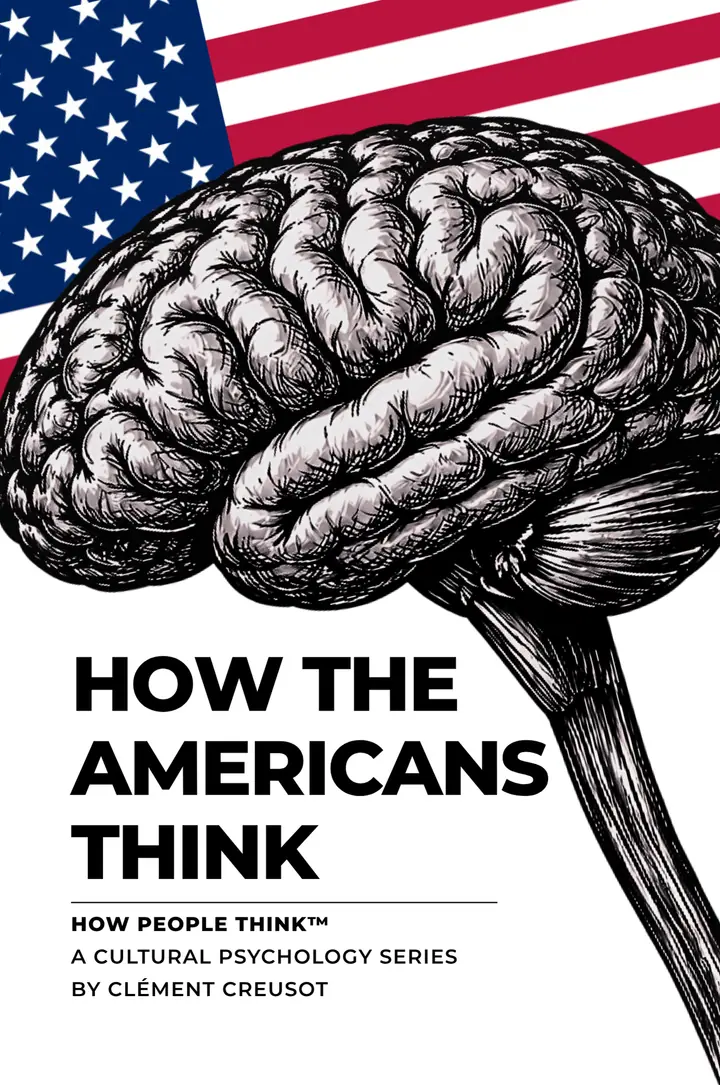
Rather than hand you a list of fixed answers, this book asks why certain American behaviors make sense from inside the culture. It gives you terms and frames that can help explain Americans, and later, any community you may try to understand.
To do that, you first have to notice your own frame of reference.
The Universal Thinking Trap
The trap is easy to name and hard to avoid: we mistake our own way of thinking for the way of thinking.
Not just one way among others, but the way: the normal one, the reasonable one, the one that needs no explanation.
So when a foreigner does something that surprises us, such as smiling for no obvious reason, calling the boss by a first name on the first day, or speaking about a divorce to someone they have just met, our first reflex is rarely curiosity. We do not immediately ask, “What frame of reference makes this natural?” More often, we judge. Strange. Superficial. Intrusive. Too informal. Too much.
We place our own norms over the other person and, when they do not fit, we decide that they are the one who is odd.
This mechanism is not limited to the provincial or the inexperienced. We are all inclined to treat our own culture as the starting point for judging everyone else. The psychologist who has never left their hometown and the traveler who has crossed forty countries can fall into the same trap. The traveler may simply do it with more sophisticated vocabulary and better stories.
This book draws on tools developed by researchers who have spent their lives making these invisible differences visible.
Jonathan Haidt has described morality as something with six receptors rather than one. Geert Hofstede mapped measurable differences between societies, including individualism and attitudes toward hierarchy. Hazel Markus and Shinobu Kitayama showed that the “self” is not built in the same way everywhere.
Ruth Benedict helped distinguish between shame and guilt as different social regimes. Michele Gelfand studied how some societies hold norms tightly while others allow them to remain looser.
These names will return when they help illuminate a specific American behavior. For now, the important point is modest: the tools exist. This book uses them not to replace experience with theory, but to clarify impressions that might otherwise harden into café arguments or lazy stereotypes.
How This Book Works
The book is organized in three parts, moving from basic assumptions to visible behavior.
Part I: The Operating System. This is the hidden foundation: origins, non-negotiable values, and the words through which Americans often think before they know they are thinking. It explains the assumptions that keep shaping judgment even when no one is naming them, including many Americans themselves.
Part II: The Social Code. This is interaction: how Americans communicate, what they leave unsaid, how trust is offered, tested, and withdrawn, who has power, and why power often tries to look casual. It also follows how emotions appear in public and where they go when they are held back.
Part III: The Lived World. This is ordinary life made concrete: time, meals, rituals, work, money, and negotiation. It ends with a practical decoder for weak signals, common situations, and things to do or avoid in daily encounters.
By the end, you will not have become American. That is not the aim. But you will have words for patterns most Americans themselves rarely describe, because habits feel obvious from inside them.
What This Book Is Not
This book is about Americans.
Not all Americans. Not every American.
More than 330 million people do not think the same way.
The engineer from San Francisco and the farmer from Iowa, the evangelical pastor from Tennessee and the vegan artist from Portland, the factory worker from Michigan and the doctor from Manhattan, the Cuban grandmother from Miami and the fisherman from Maine do not live identical lives or hold identical views.
They share certain assumptions and habits, but each carries them differently.
So the book describes tendencies, not laws. Every claim should be heard with an implicit “in general.” Every American you meet retains the right to contradict the pattern.
Nor is this book a trial. It is not a tribute either.
Some American tendencies may charm you: the belief that a person can start over, the quick warmth toward strangers, the habit of dreaming aloud, the willingness to treat failure as part of trying.
Others may irritate you: positivity that can slide into denial, conversation that stays on the surface, the quiet assumption that America is the center of the story, and the way people who cannot keep up may be left behind.
This book does not decide for you. It tries to explain. It gives you a framework for interpretation. The judgment remains yours.
The Starting Question
The book starts with a question Americans have been asking themselves since the country’s birth, often without saying it directly: who are we going to become?
The answer is not simple. It passes through a revolution, a moving frontier, public pledges, and everyday encounters where strangers talk as if acquaintance could begin immediately.
That question is where the book begins.